
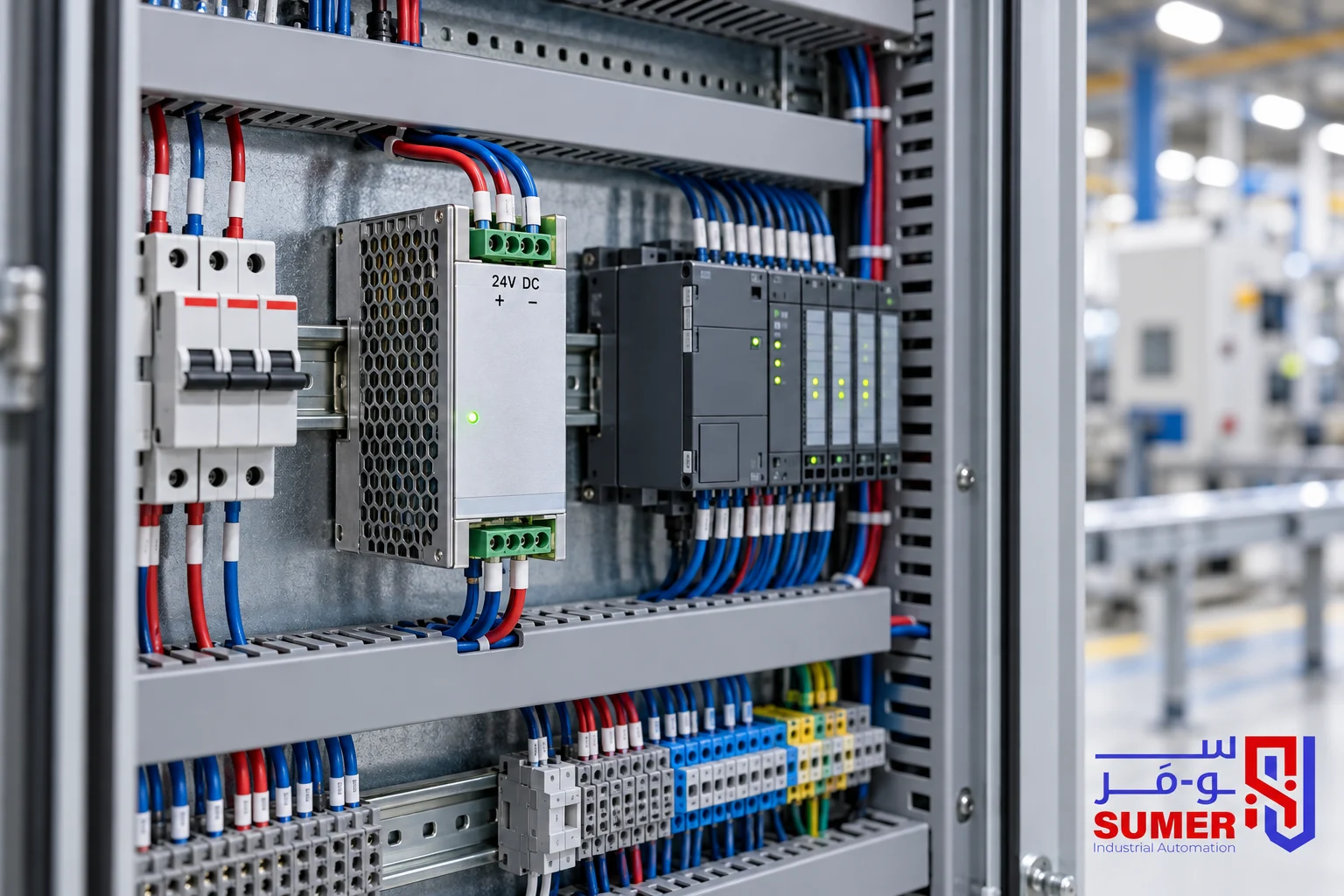
A 24V Power Supply is used inside control panels to convert AC input voltage to a stable 24V DC output needed by components like PLCs, HMI screens, sensors, and relays. Choosing an industrial power supply does not depend on voltage alone; rather, you must calculate the total load current, review the inrush current, temperature, mounting method, protections, and the possibility of future panel expansion.
An inappropriate choice may lead to voltage drops, controller reboots, loss of communication with devices, or intermittent downtime that is difficult to diagnose. Therefore, this guide explains how to calculate capacity, the difference between the most popular types of industrial power supplies, and how to choose the right Delta model for your application without buying less capacity than required or unnecessarily overpaying for too much.
SUMER provides a range of industrial power supplies from Delta with different capacities for control panels, machines, and production lines. Send your load data or a picture of your current model to the SUMER team for a technical recommendation and a suitable quotation.
What is an Industrial 24V Power Supply?
A 24V Power Supply is a device that receives electrical voltage from a source, then converts it into a regulated 24V DC output to feed control devices. In industrial applications, the input is mostly AC, while the control circuits and electronics inside the panel require a stable DC voltage appropriate for their specifications.
This device is also known as a 24-volt power supply or SMPS (Switched-Mode Power Supply). SMPS refers to a power supply that operates using electronic switching technology, which helps provide good efficiency and a compact size compared to traditional conversion solutions, with varying performance and protections depending on the series and model.
An industrial power supply is not a computer power supply, nor is it necessarily a battery charger. Each product has a specific design, specifications, and use, so you must choose a device dedicated to the control panel environment and compatible with the load it will feed.
What is the difference between Input Voltage and Output Voltage?
-
Input Voltage: The voltage that reaches the power supply from the source, which must fall within the range specified in the datasheet.
-
Output Voltage: The continuous voltage that the power supply provides to the loads; in this guide, it is 24V DC.
-
Output Current: The maximum nominal current the model can provide under specified operating conditions, such as 3.125A, 5A, 10A, or 20A.
-
Output Power: The available power in watts, which equals the voltage multiplied by the current.
Why is 24V DC output used in control panels?
The 24V DC voltage is widely used in automation systems because it is compatible with a large number of controllers, sensors, operator interfaces, and auxiliary components. It also makes it easier to create a control circuit separate from the power circuit of motors and large loads.
This does not mean that every industrial device automatically runs on 24 volts; the reference is always the device's data and datasheet. Some components may require a different voltage, a higher current, or a separate source due to the nature of the load or the requirements for isolation and stability.
Inside electrical control panels, choosing the right power source helps stabilize the control circuit and reduce malfunctions caused by voltage drops or overloading the supply beyond its capacity.
Where is the 24V power supply used inside factories?
A 24V power supply is used in various industrial applications. Some of the most common loads it feeds include:
-
PLCs and I/O modules.
-
HMI screens and machine operator interfaces.
-
Industrial sensors, measuring devices, and transmitters compatible with 24V DC.
-
Relays, contactor coils, and valves operating at 24V DC.
-
Communication modules, signal distributors, and some industrial network components.
-
Alarm circuits, signals, and compatible industrial lights.
-
Control panels in packaging machines, conveyors, and assembly lines.
-
Monitoring and control systems, and upgrading old machines.
Before connecting more than one load to a single power supply, you must calculate the consumption of all components, taking into account inrush currents and variable loads. In sensitive applications, separating some loads onto independent sources or circuits might be better than grouping them all on a single source.
Types of Industrial Power Supplies
There are several forms of industrial power supplies, and choosing the right type depends on the panel design, operating environment, and the nature of the input source.
DIN Rail Power Supply This type is mounted directly on a DIN rail inside the control panel, which is why it is heavily used with PLCs, HMIs, and relays. Its compact design helps organize components and allows for easy removal and replacement, but you must adhere to the ventilation clearances and mounting orientation stated in the model's manual.
Enclosed Power Supply This comes inside a metal chassis or a dedicated casing, and may suit different applications depending on the mounting method, protection degree, and ventilation. This type should not be chosen by shape alone; you must review the insulation, cooling, and wiring specifications, as well as its suitability for the panel.
Single-Phase and Three-Phase Power Supply Some models operate from a single-phase input, while others are designed for three-phase input and higher capacities. You should not assume a model's compatibility with the available power source; carefully review the input range and number of phases before purchasing or connecting.
How to calculate 24V Power Supply capacity
The selection process begins by calculating the current and power required for all loads that will operate on the 24V DC output. The following relationships can be used:
-
Power (Watts) = Voltage (Volts) × Current (Amperes)
-
Current (Amperes) = Power (Watts) ÷ Voltage (Volts)
For example, a power supply with a 24V DC output and a 5A current provides a nominal capacity of: 24V × 5A = 120W
Correct Calculation Steps
-
List all devices that will be connected to the 24V DC output.
-
Extract the nominal current or required power for each device from its datasheet.
-
Convert power to current when needed using the formula A = W ÷ 24V.
-
Sum the consumption of the loads that could operate at the same time.
-
Review the inrush current or temporary pulses for loads like valves, relays, and some electronic devices.
-
Add a suitable design margin for expansion and operational changes, according to the nature of the loads and the manufacturer's instructions.
-
Review the impact of temperature and mounting method on the available capacity, because some models require load derating in certain conditions.
Simplified Practical Example Let's assume a control panel contains the following 24V DC loads:
-
PLC and expansion modules: 1.2A
-
HMI screen: 0.8A
-
Sensors and measuring devices: 0.5A
-
Relays and valves operating simultaneously: 1A
-
Total Nominal Current: 3.5A
If the design engineer adopts a 25% margin after reviewing inrush currents and operating conditions, the approximate design current becomes: 3.5A × 1.25 = 4.375A
In this case, a 24V, 5A model with a capacity of 120W might be initially suitable, provided you confirm inrush currents, temperature, load distribution, expansion requirements, and all datasheet conditions. This example is for clarification and is not a substitute for studying the actual panel.
How to choose the right 24V Power Supply?
After calculating the load, review the following criteria before choosing a model:
-
Input Voltage Range: Ensure the input range in the datasheet matches the power source inside the panel. Do not rely solely on the nominal voltage written in the product name, and do not connect a three-phase source to a single-phase model or vice versa.
-
Output Current and Power: The available current must cover total simultaneous loads and inrush currents with a suitable margin. Choosing 24V is not enough; a 3.125A model differs from a 5A, 10A, or 20A model in the power it can provide.
-
Output Stability and Power Quality: PLCs, HMIs, and sensors need stable feeding within permissible limits. Review voltage regulation, ripple, and response to load changes when these factors affect the application.
-
Built-in Protections: Review the types of protection the model offers, such as overcurrent, short circuit, overvoltage, or overtemperature protection, and the method of restoring operation after the fault is cleared. These details vary between series, so do not assume them without checking the datasheet.
-
Temperature and Derating: High temperatures inside the panel may reduce the available power from the supply. Review the derating curve and temperature limits, and leave the required ventilation and clearances instead of running the device at maximum load in a hot environment without calculation.
-
Mounting Method and Space: Measure the available space on the DIN Rail, and leave room for wiring, ventilation, and maintenance. A compact design is useful, but crowding components can raise the temperature and make accessing terminals difficult.
-
Nature of the Load and Inrush Current: Not all loads behave the same way. Some components draw a higher momentary current upon startup, and some change their consumption with the machine's state. Therefore, you must study the worst-case operating scenario, not just sum the nominal values.
-
Expansion and Operation Continuity: If the panel can accommodate additional sensors, I/O modules, or another screen, include the expected expansion in your calculation. In applications that cannot tolerate downtime, you may need a backup feeding architecture or to separate critical loads, according to an engineering study of the system.
Comparison of Delta 24V Power Supply models available at SUMER
SUMER provides several Delta DIN Rail Power Supply models with 24V DC output. The following list highlights the main power and current differences, but it does not replace reviewing the product page and datasheet before making a final choice:
-
Model: Delta DRL-24V75W1AZ
-
Output: 24V DC
-
Current: 3.125A
-
Power: 75W
-
Input Range: 85–264VAC
-
Initial Use: Small control circuits where the current covers all loads and operating conditions.
-
-
Model: Delta DRL-24V120W1EN
-
Output: 24V DC
-
Current: 5A
-
Power: 120W
-
Input Range: Universal AC Input
-
Initial Use: Medium control panels containing a PLC, HMI, and suitable 24V loads.
-
-
Model: Delta DRL-24V240W1EN
-
Output: 24V DC
-
Current: 10A
-
Power: 240W
-
Input Range: 90–264VAC
-
Initial Use: Control circuits with larger loads or a higher number of components.
-
-
Model: Delta DRL-24V480W1EN
-
Output: 24V DC
-
Current: 20A
-
Power: 480W
-
Input Range: 90–264VAC
-
Initial Use: Applications requiring a higher current after studying load distribution and protection.
-
Do not choose a model from this list based on power alone. You must review the input voltage, temperature, derating curve, inrush currents, space, protections, and application approvals. You must also check the model's availability at the time of ordering.
Need a quick and accurate selection? Send your list of 24V DC loads, the power or current of each load, the input voltage, and the panel temperature to the SUMER team to get a technical recommendation and a quotation.
24V Power Supply Installation and Protection Tips
The installation and wiring of the power supply must be done by a qualified technician or engineer according to the electrical diagram and the manufacturer's instructions. Key points include:
-
Disconnect the power source and verify the absence of voltage before wiring or maintenance.
-
Connect L, N, and PE or the correct input terminals according to the model, with proper grounding.
-
Use a wire cross-section, breakers, and protection that comply with the circuit current and installation conditions.
-
Check the polarity before connecting the +24V and 0V output to the devices.
-
Leave the required ventilation clearances and do not cover the cooling vents.
-
Separate power cable routing from signal cables as much as possible according to the panel design.
-
Distribute loads on protected and documented branches instead of an unorganized output that is hard to trace.
-
Number wires and terminals, and update the diagram after any modification.
-
Measure the output and verify its stability under load before handing the panel over for operation.
-
Do not adjust the output voltage outside the allowable range for the supply and the connected loads.
Working inside a live electrical panel can cause electric shock, fire, or equipment damage; therefore, measurements or modifications should only be carried out by a qualified person using proper safety procedures and tools.
Symptoms of choosing an inappropriate 24V power supply
A power supply problem might appear as an intermittent fault rather than a complete shutdown. Symptoms that require investigation include:
-
The PLC or HMI screen reboots when another load starts.
-
A 24V voltage drop when turning on valves or contactors.
-
Frequent loss of communication between control devices.
-
Unstable readings from certain sensors.
-
The power supply overheating or entering protection mode.
-
The panel working without issues while idle, then stopping under full load.
-
Frequent blowing of fuses or tripping of breakers.
-
Correct voltage is present with no load, but drops after loads are connected.
These symptoms alone do not prove that the power supply is defective; the cause could be a short circuit in one of the branches, unsuitable wiring, a loose terminal, an overload, or a grounding or ventilation problem. Troubleshooting starts with systematic measurement and reviewing loads, branches, and the diagram by a qualified technician.
Common mistakes when buying a 24V Power Supply
-
Choosing by voltage only: Ignoring current and power often leads to overloading.
-
Not calculating simultaneous loads: Components might work individually, but the voltage drops when they operate together.
-
Ignoring inrush current: The nominal value does not always explain what happens at the moment of startup.
-
Operating at the maximum limit without review: Temperature, ventilation, and derating can reduce available power.
-
Buying a model incompatible with the input: A difference in voltage or the number of phases may prevent operation or cause damage.
-
Not leaving room for expansion: Adding sensors or I/O later may require changing the entire supply.
-
Relying on an undocumented product: The absence of a datasheet and technical support makes selection and maintenance much harder.
What factors determine the price of a 24V Power Supply?
There is no single price for all power supplies, as the price varies based on the model, availability, and specifications. The most important factors include:
-
Output current and power, such as 75W, 120W, 240W, or 480W.
-
Input voltage range and type (single-phase or three-phase).
-
Product series and mounting method (DIN Rail or other).
-
Efficiency, power density, and dimensions.
-
Protections, technical features, and required approvals.
-
Thermal and environmental operating conditions.
-
Model availability and the required quantity.
-
The need for a full panel study or technical support to find an alternative to an old model.
To get an accurate price, send the required model code or load data to SUMER. If you don't know the model, send a picture of the devices' data plates, the number of loads, the required current or power, and the available input voltage.
Why choose a Delta Power Supply from SUMER?
The goal is not just to sell a larger capacity power supply, but to choose a capacity and model that match the panel and the nature of the operation. SUMER helps you by:
-
Reviewing 24V DC loads and initially calculating the required power.
-
Recommending a suitable Delta Power Supply model for the application.
-
Selecting components compatible with the PLC, HMI, and the rest of the control system.
-
Suggesting a suitable alternative when upgrading a panel or replacing an old model.
-
Preparing integrated solutions for control panels, machines, and production lines.
-
Providing technical support before and after the purchase based on project requirements.
If your control panel includes a PLC and an operation screen, you can also review the guide on programming HMI screens and connecting them with a PLC to understand the role of the operator interface and how it integrates with the control system.
Request your recommendation now: Contact SUMER and send the input voltage, a list of 24V loads, the current of each load, the panel temperature, and a picture of the current power supply if available; the team will assist you in choosing the right model and provide a quotation.